
Megahertz-Sampled Observations of AC Level 2 Onboard Electric Vehicle Charging
Energy and Power Measurements on a Nonsinusoidal 345 kV System Using Three-Phase Megahertz Time-Series Data
This paper investigates time-domain metering approaches and references measurements of a 345 kV transmission line. A new power quality metric, “electric energy factor,” is introduced as an alternative to power factor utilization measurement under distorted conditions.
It’s About Time—Considerations and Requirements for DSS and Line Current Differential Applications
This paper discusses considerations that a protection engineer must evaluate for a line current differential protection scheme when applying GNSS (Global Navigation Satellite Systems) for data alignment. Time-synchronization protocols, such as IRIG-B, IEEE C37.118, IEEE 1588 Precision Time Protocol (PTP), and the distribution of the time signal must be applied using the best practices, as discussed in this paper, to ensure a robust and secure design. Commissioning tips are also provided to help guide successful implementation of time into the various protection schemes. Finally, the paper presents four cases highlighting line current differential and DSS-based applications where an improper time-source configuration led to undesired behavior of the protection scheme. These cases focus on the time-source installations and how the time-source configuration led to the undesired behavior.
Practical Experience With High-Impedance Fault Detection in Distribution Systems—Continued
This paper provides further application experience, event analysis, and lessons learned from PPL Electric Utilities use of an HIF algorithm to detect and isolate high-impedance faults.
Using Software-Defined Networking to Build Modern, Secure IEC 61850-Based Substation Automation Systems
This paper discusses an application of software-defined networking (SDN) to meet stringent network performance and cybersecurity requirements. It compares this application to traditional spanning-tree-based networks to show SDN’s ability to meet and exceed those requirements.
Analysis of Selected Motor Event and Starting Reports
This paper investigates several real-world events with data from both motor starting reports and event records. The data demonstrate the value of having devices capable of recording motor data during starts and fault events and of capturing and reviewing such data for the purpose of determining root cause.
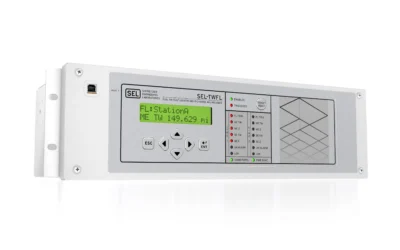
Introducing the SEL-TWFL Dual Traveling-Wave Fault Locator and 12-Channel MHz Recorder
Schweitzer Engineering Laboratories (SEL), a global leader in power system protection, automation, and control solutions, introduced the SEL-TWFL Dual Traveling-Wave Fault Locator and 12-Channel MHz Recorder, a standalone device that provides accurate fault locating, line monitoring and high-resolution event recording.
Let’s Talk About Your Next Project.
Connect with our team to address technical challenges, assess system requirements, and provide a proposal with lead times.